
Recipients of the 2025 Jane Addams Children’s Book Awards were announced today by the Jane Addams Peace Association. Since 1953, the Jane Addams Children’s Book Award annually recognizes children’s books of literary and aesthetic excellence that effectively engage children in thinking about peace, social justice, global community, and equity for all people.
2025 Winner in the Picture Book Category
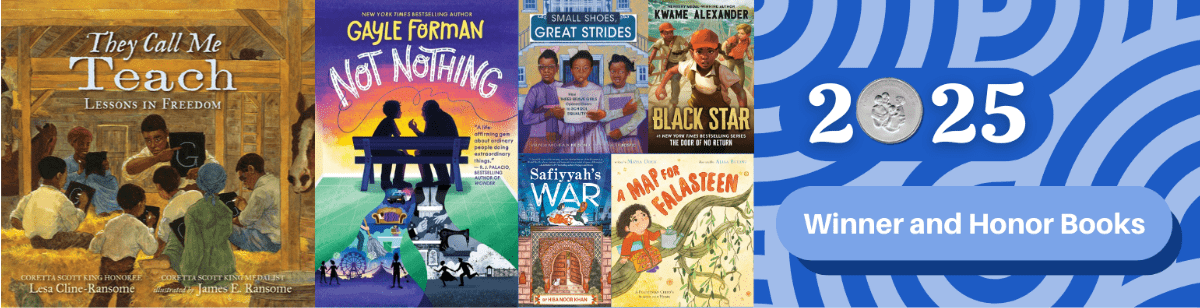
They Call Me Teach: Lessons in Freedom, written by Lesa Cline-Ransome, illustrated by James E. Ransome, and published by Candlewick Press. They Call Me Teach: Lessons In Freedom is a powerful and poignant story that explores the transformative power of education as an act of resistance. Ayoung enslaved man, affectionately called Teach, secretly learns to read, write, and perform arithmetic alongside his enslaver’s son Thomas.
The narrative unfolds over a week in the life of the fictional character, Teach, and demonstrates what it takes to live in liberatory literacy. They Call Me Teach is not just about the liberation of a person, but also the literacy freedom of a people who are legally denied the right to read. Cline-Ransome captures the significance of literacy, not just as personal liberation, but also as a collective act of defiance against oppression. Teach’s story becomes a symbol of resilience and hope, utilizing stirring words and strong speech to help us understand the power that comes through resistance, and the gravity of what was at stake as Teach rose to empower a people to read.
Cline-Ransome’ uses lyrical, vivid language and emotional depth to bring Teach’s experiences to life. Through Teach’s voice, readers feel the weight of what was at stake—the punishments he could face if caught, the pain of being seen as property rather than as a human being, and the profound courage it took to defy these barriers. The narrative illustrates how Teach’s determination to learn and to educate others becomes a revolutionary act, turning simple lessons in letters and numbers into a larger fight for dignity and freedom.
James E. Ransome’s watercolor illustrations are equally masterful. He uses the interplay of light and shadow to reflect the dualities in Teach’s life: the hope and joy found in education against the backdrop of oppression and fear. The warm, golden tones of scenes where Teach shares knowledge contrast with the darker, muted shades of moments that reflect danger and the dehumanizing reality of being enslaved. Ransome’s bold lines and striking compositions convey the emotional intensity of the story. This visual dynamic deepens the narrative’s impact, to show both the enduring strength and continuous struggle that was the truth of enslaved African Americans.
This book serves as a tribute to the resourcefulness and resilience of enslaved African Americans, and demonstrates how education was both a tool of survival and also a form of resistance. It sheds light on the courageous acts of those who risked everything to gain knowledge and share it with others, ensuring that the fight for freedom extended beyond shedding physical chains to the realm of freeing the mind and spirit.
With its compelling narrative and evocative illustrations, They Call Me Teach is a powerful reminder of the enduring importance of education in the fight for justice and equality. It is an essential addition to classrooms and libraries, offering readers a window into history and the unyielding human desire for freedom and self-determination.
2025 Winner in the Chapter Book Category
Not Nothing, written by Gayle Forman, and published by Aladdin Books, an imprint of Simon & Schuster. Gayle Forman’s Not Nothing is a poignant and thought-provoking middle-grade novel that skillfully explores the themes of compassion, rehabilitation, forgiveness, and humanity through the intertwined stories of two unlikely companions: Alex, a troubled twelve-year-old boy, and Josey, a 107-year-old woman living in a retirement home. The novel addresses complex issues with sensitivity and insight, offering young readers a meaningful exploration of personal growth, healing, and the profound impact that human connection can have on one’s life. The story artfully explores the transformative power of connection and redemption.
When we first meet Alex, he is sullen, resentful, and less than hospitable toward the residents and staff at the retirement home. His emotional walls seem impenetrable, but as he begrudgingly completes the tasks assigned to him and begins to see the residents’ gratitude, a tender shift occurs. Alex starts to open his heart, forming meaningful connections and revealing the pain that caused him to shut others out. Bit by bit, the reasons behind Alex’s emotional armor and his “very bad thing” are unveiled, drawing readers into his story with empathy and understanding.
Josey, the narrator, recounts the events to Olka with a unique omniscience that might initially confuse readers, but this perspective proves essential to the narrative’s depth. Josey’s own backstory, set in Nazi-occupied Poland, interweaves with Alex’s journey, creating a powerful parallel about love, resistance, survival, and the second chances life offers. His story serves as a poignant reminder of the resilience of the human spirit, even amidst unimaginable hardship.
Forman’s writing is empathetic and reflective, drawing readers into the emotional lives of both characters. She deftly balances humor, tenderness, and heartbreak, creating a narrative that is both engaging and thought-provoking. The book’s pacing is deliberate, allowing the relationship between Alex and Josey to develop naturally, without rushing their emotional growth. This allows readers to become fully invested in the characters’ journeys and to experience the transformative power of connection firsthand.
Not Nothing echoes the tenderness and emotional resonance of R.J. Palacio’s Wonder—a comparison reinforced by Palacio’s blurb on the cover. Like Wonder, this novel is a heart-wrenching, uplifting story of personal growth, kindness, and the courage to rise above past mistakes.
Gayle Forman’s deft writing captures the fragility and strength of the human condition, making Not Nothing a story that lingers long after the final page. With its intricate narrative, unforgettable characters, and timeless message, this book is a must-read for all ages.
Two Honor Books were named in the Picture Book category:
Small Shoes, Great Strides: How Three Brave Girls Opened Doors to School Equality, written by Vaunda Micheaux Nelson, illustrated by Alex Bostic and published by Carolrhoda, an imprint of Lerner Books; and A Map for Falasteen, written by Maysa Odeh, illustrated by Aliaa Betawi, and published by Henry Holt Books for Young Readers, an imprint of Macmillan.
Small Shoes, Great Strides tells the story of Leona Tate, Tessie Prevost and Gail Etienne. Better known as the McDonogh Three, these girls were at the forefront of school desegregation in New Orleans, alongside Ruby Bridges. Readers follow them from their first day of first grade through the remainder of their first year at McDonogh No. 19 Public School, and the weeks and years following.
Nelson does not shy away from the painful truths of the sensitive and scary position the girls found themselves in. Bostic shows crowds of white protestors outside the school while Nelson describes white parents who withdrew their children from McDonogh. Nelson also highlights the relationships the girls formed with the white adults who educated them and kept them safe; Miss Meyers, the “kind and caring” first-grade teacher, and the three U. S. Marshals who escorted them daily to and from school, even holding the girls’ hands.
Bostic’s acrylics add emotional depth to the story. The protesters outside, shown in warm-toned orange, contrast with the girls, often dressed in cool blues and purples. Bostic’s art brings to life the facts of school desegregation at McDonogh No. 19 public school – classroom windows covered with brown paper, recesses spent in stairwells for safety, and drinking fountains decommissioned due to fear of poisoning.
A Map for Falasteen describes a dilemma for Falasteen when her school class is tasked with finding their families’ home countries on a map. Despite her determined search, Palestine is nowhere to be found. This absence sparks a journey of discovery, as Falasteen turns to her family for answers.
Her grandparents, father, and mother respond not with maps but with vivid stories, cherished traditions, and enduring memories of their homeland. Through these personal narratives, Falasteen learns to see Palestine not just as a physical place, but as a living tapestry of culture, history, and identity. A Map for Falasteen stands out as a profound book to spark meaningful discussions about the erasure of nations due to war and injustice. It powerfully conveys how preserving traditions and memories serves as a form of resistance, ensuring that a culture’s essence endures despite adversity.
Two Honor Books were also named in the Chapter Book category:
Black Star, written by Kwame Alexander, published by Little Brown Books for Young Readers; and Safiyyah’s War, written by Hiba Noor Khan, and published by Allida, an imprint of HarperCollins.
Black Star is an emotionally rich and beautifully crafted middle-grade novel-in-verse that immerses readers in the life of Charley Cuffey, a gifted young baseball player growing up in the segregated South of 1920s Virginia. With its lyrical prose, vibrant characters, and powerful themes of resilience and hope, Black Star exemplifies literary excellence and serves as a compelling exploration of justice, identity, and perseverance.
At its heart, Black Star is a story of courage and determination in the face of systemic injustice. Charley, whose exceptional talent for baseball offers her a vision of a brighter future, navigates a world shaped by racism, violence, and inequity. Her passion for the game serves as both a refuge and a metaphor for her struggle to find her place in a society that seeks to limit her potential. Charley’s family plays a central role in her journey, with her grandfather standing out as a figure of wisdom and strength. This narrative thread not only invites reflection on historical injustices but also highlights the intergenerational resilience and love that sustain Charley through her challenges.
Alexander’s verse expertly weaves together themes of perseverance, family, and community. Through its richly drawn characters, poignant historical context, and exquisite verse, Black Star encourages purposeful reflection and deep questioning. It asks readers to consider how they can confront injustice in their own lives, foster empathy, and work for equity and peace.
Safiyya’s War is a powerful blend of historical fiction and a compelling narrative that resonates deeply with the themes of peace, social justice, global community, and equity. As seen through the eyes of Safiyyah, a young Muslim Parisian girl living in the Grand Mosque of Paris during World War II, the novel brings to life the courage and compassion of everyday individuals resisting the injustices of the Holocaust. These acts of solidarity across religious and cultural divides reflect the profound necessity of standing together against oppression. Safiyyah’s bravery and compassion showcase how individuals, even young ones, can act as agents of peace and justice. The story also fosters an appreciation of the global community by highlighting the Muslim community’s role in resisting the Nazi regime, a narrative often overlooked in Holocaust history. The interweaving of historical and fictional elements ensures the story is both educational and emotionally resonant. It introduces readers to a lesser-known chapter of Holocaust history while engaging them in the larger conversations about empathy, resilience, and what it means to stand in solidarity. Safiyyah’s journey invites readers to reflect on the ways we can all contribute to building a more just and inclusive world.
A national Selection Committee chose the winner and honor books in the Picture Book and Chapter Book categories. Members of the 2025 Jane Addams Children’s Book Award Selection Committee are: Nanesha Nuñez (Chair, NY); Natasha Grey (Co-Chair, NY), Jackie Marshall Arnold (OH), Amina Chaudhri (IL), Dora Guzman (IL), Amy Heath (GA), Rabia Khokar (ON), Heather Matthews (MD), Aura Perez (CA), Naomi Solomon (NM), Susie Rios (NY), Anthony Whaley (VA).
The 2025 Jane Addams Children’s Book Awards ceremony will be held on April 24, 2025, at the Carnegie Library of Pittsburgh Main Library Location, 4400 Forbes Avenue, Pittsburgh, Pennsylvania, at 5:30pm EST. For details about the award event, and securing winner and honor book seals, please contact the Jane Addams Peace Association at info@janeaddamspeace.org.
To read more about this year’s finalists and about the Jane Addams Children’s Book Awards, please visit: https://janeaddamschildrensbookaward.org/book-award/finalists-award-announcement-calendar/
For a complete list of books honored since 1953, please visit:
https://janeaddamschildrensbookaward.org/all-books/
To support the work of the Jane Addams Peace Association, you may make a gift here:
https://janeaddamschildrensbookaward.org/get-involved/donate/